
Last updated October 16, 2026
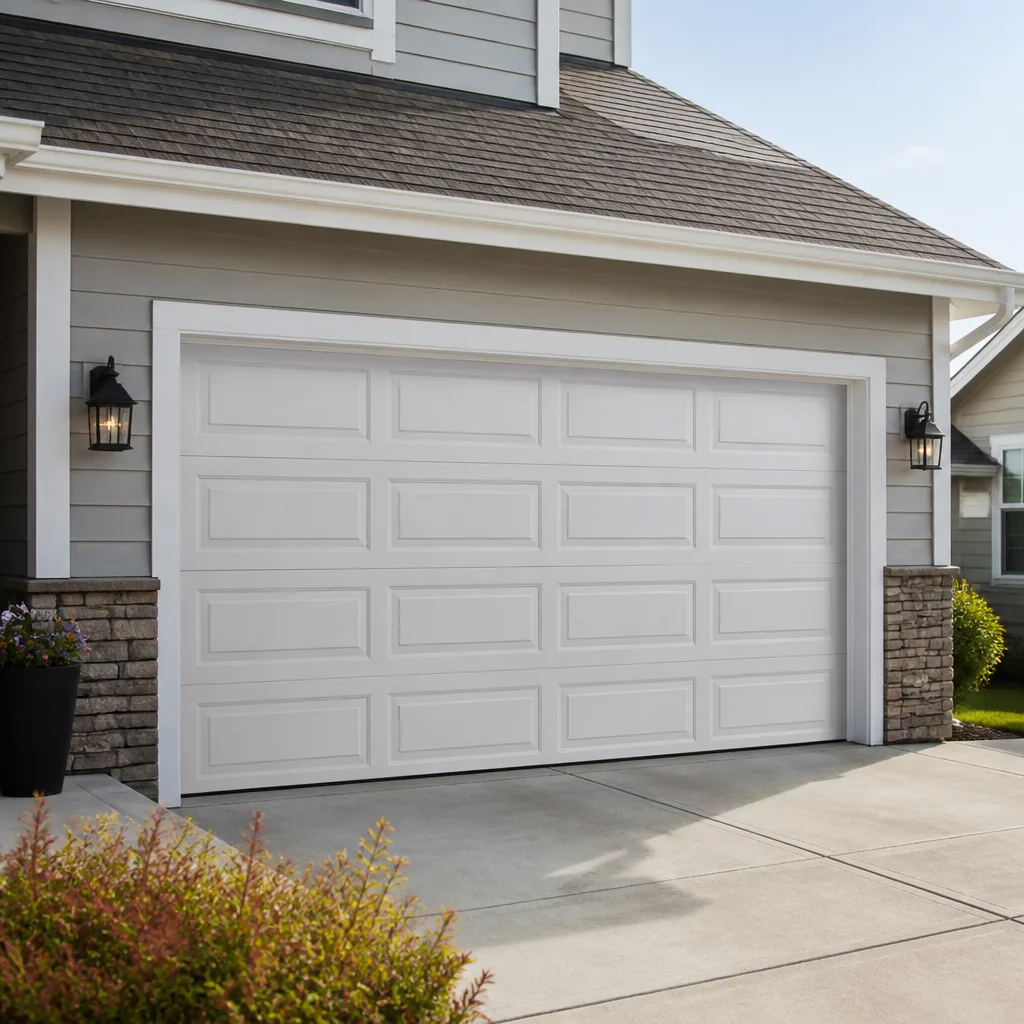 Raised-panel steel
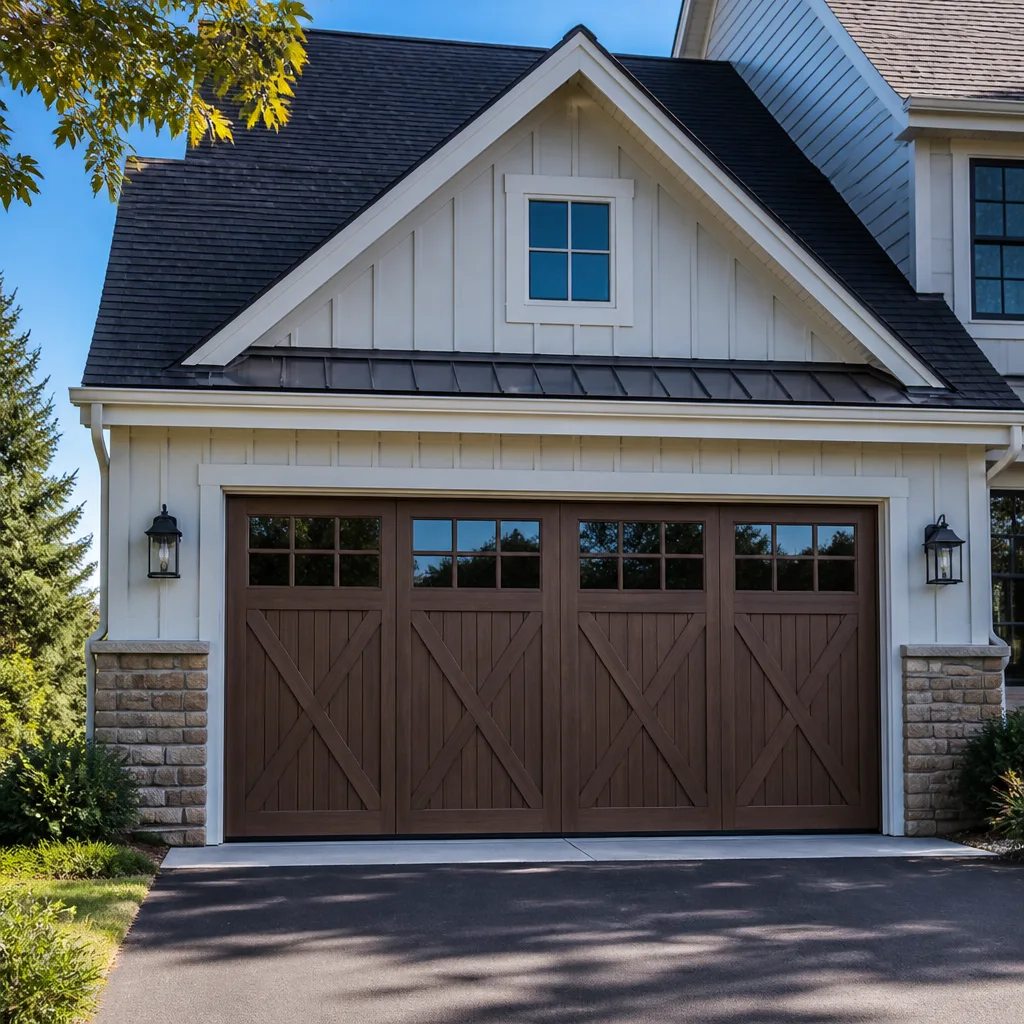 Carriage house
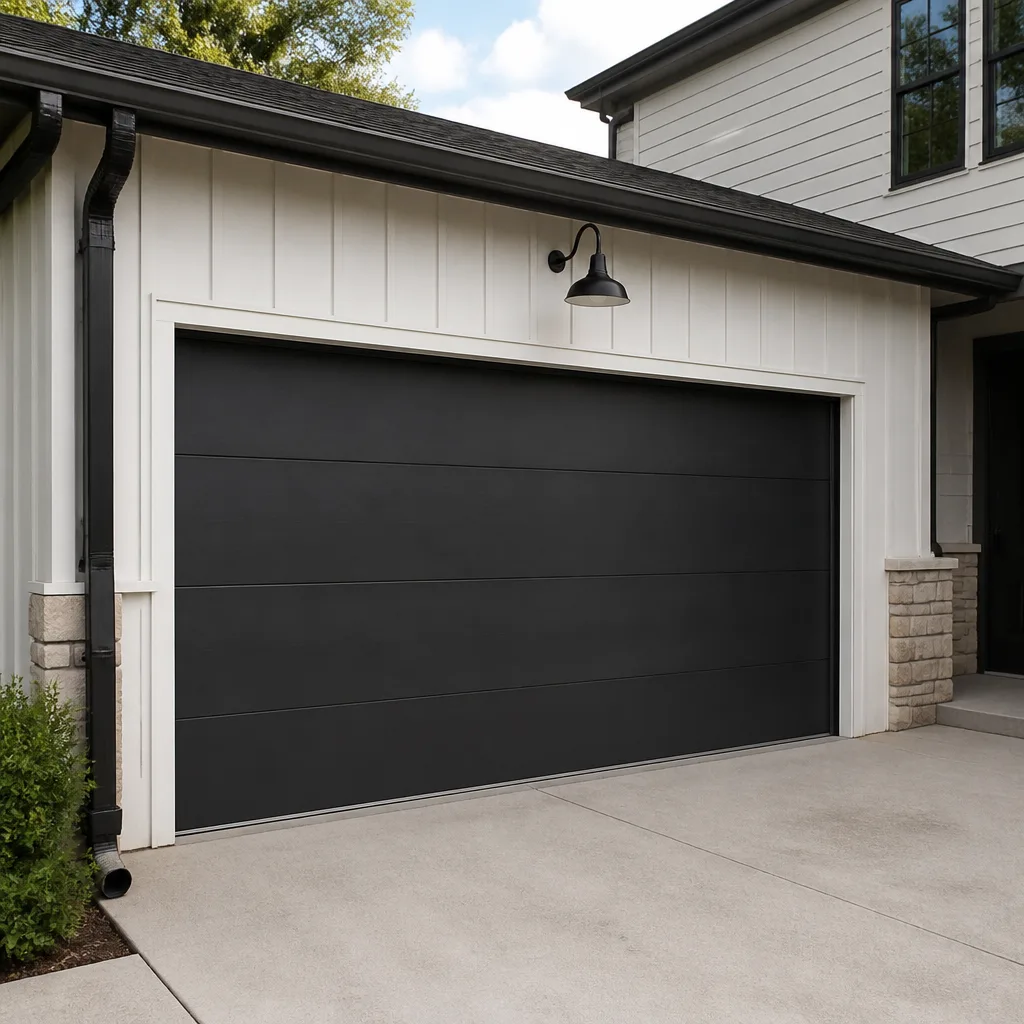 Modern flush
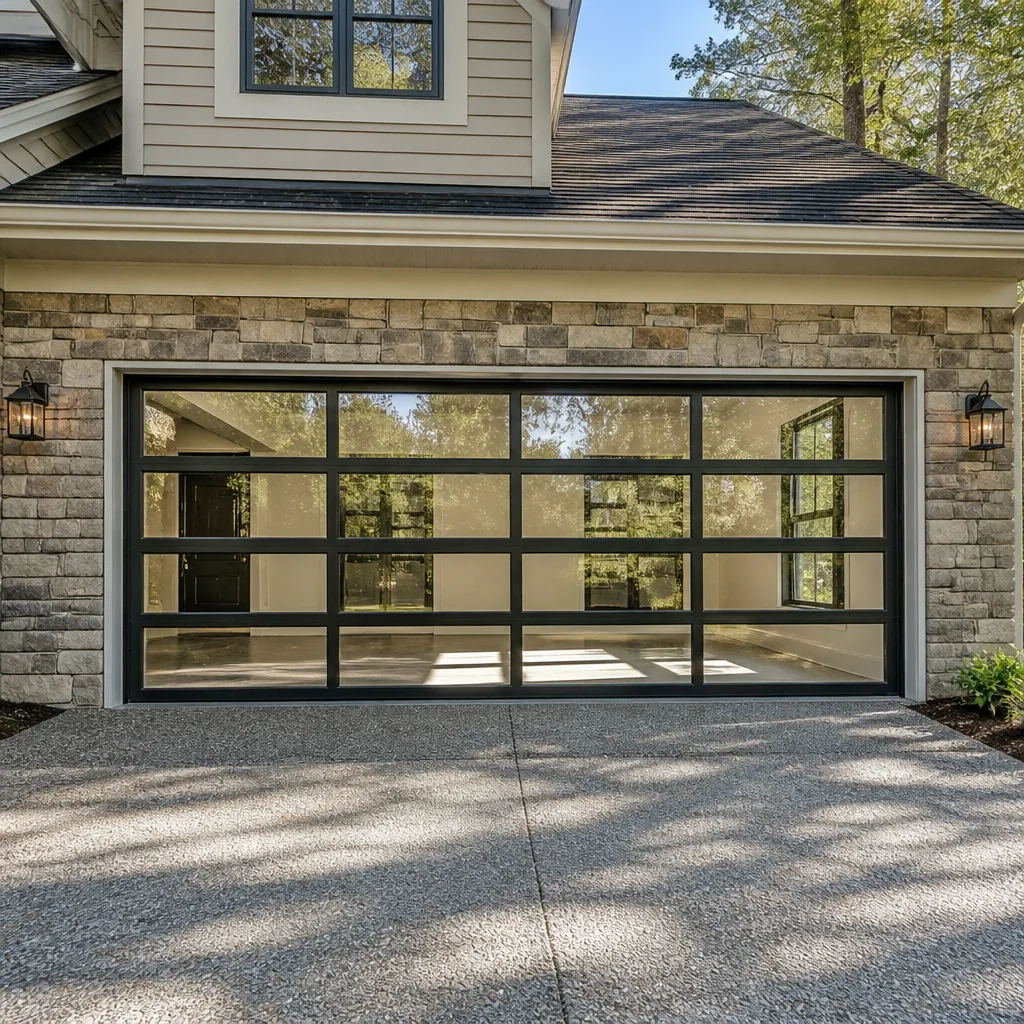 Full-view glass
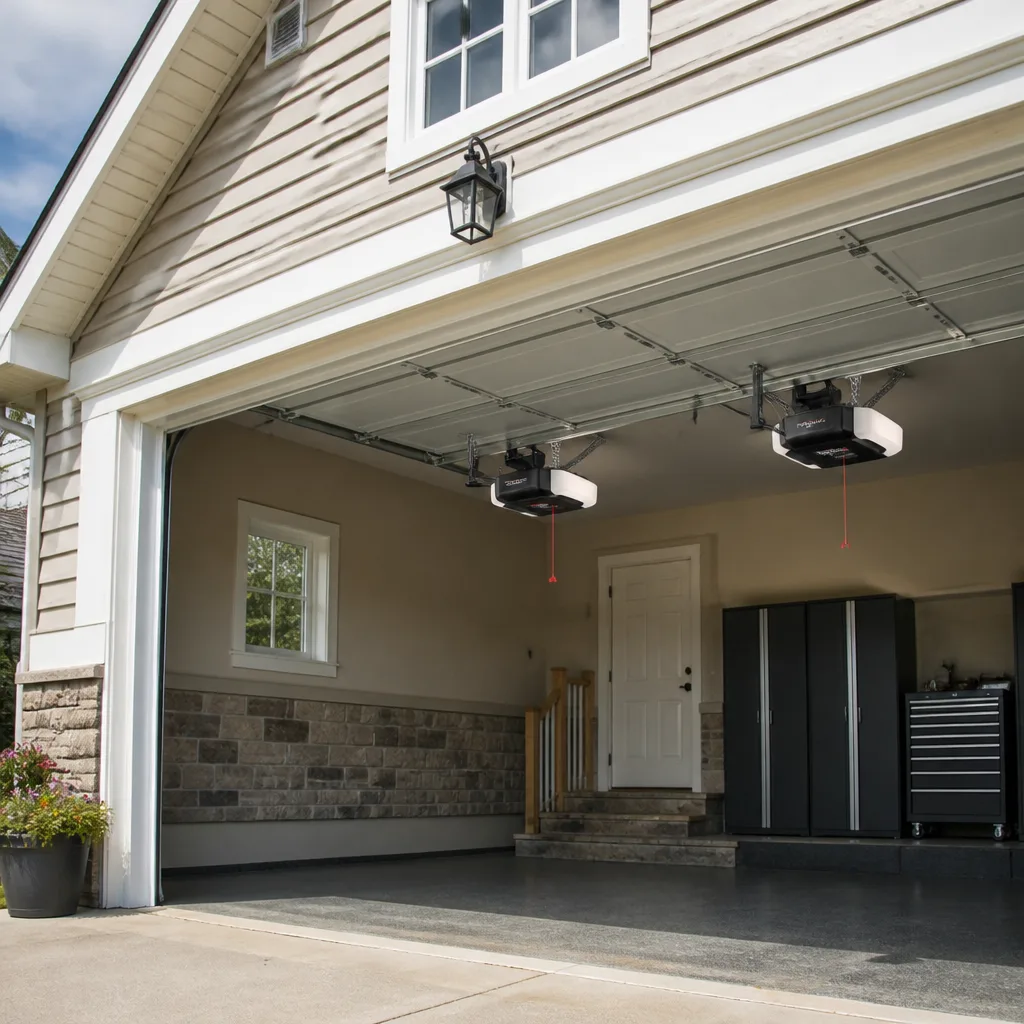 LiftMaster openers
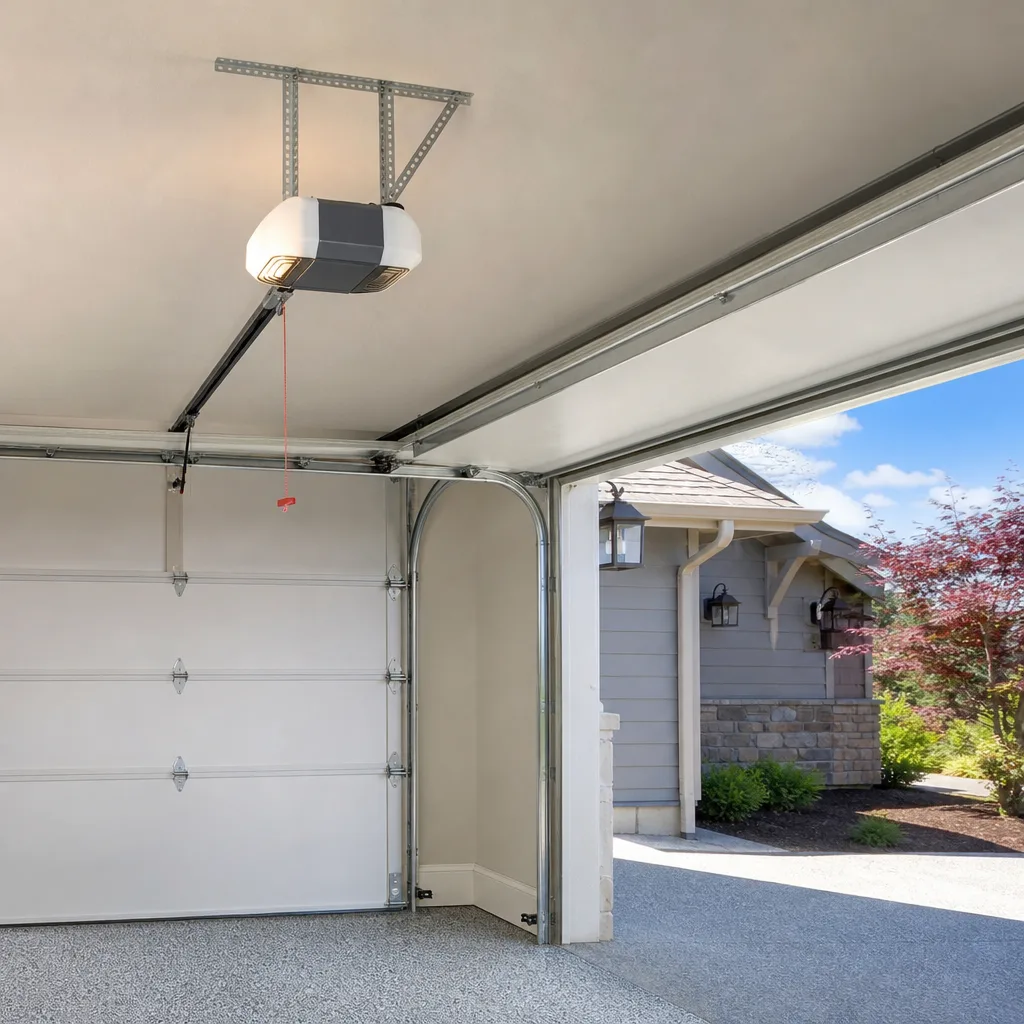 Chamberlain openers
Full 25-point door and opener safety check with every visit - springs, cables, rollers, tracks, and your LiftMaster or Chamberlain opener included
You get a price before we start. It does not change when the truck arrives.
Get your free estimateDIY vs Professional Garage Door: The Las Vegas Homeowner’s Decision Guide
A torsion spring on a double-wide garage door stores roughly 150 pounds of torque per square inch. When it snaps, that energy releases in under half a second. The Mayo Clinic’s own ergonomics research places garage door spring failures among the top five household injuries requiring surgical repair, ahead of table saw accidents. Yet every spring, Las Vegas homeowners watch a fifteen-minute YouTube video and decide they’ll save the labor cost. Some save money. Others join a statistic they could have avoided with one phone call. This guide exists because the line between a smart DIY job and a genuinely dangerous one is not about confidence. It’s about energy, metallurgy, and the specific way a Las Vegas summer behaves. By the end, you’ll know exactly which garage door tasks belong in the homeowner column, which belong in the pro column, and why the heat outside your door changes that math more than any tutorial will tell you.
Styles & brands we work with
Quick Answer
Most Las Vegas homeowners can safely handle five garage door tasks: sensor alignment, remote reprogramming, weather seal replacement, track cleaning, and manual lock lubrication. Everything involving torsion springs, lift cables, or door panel replacement carries either serious injury risk or hidden alignment complications that make professional service worth the cost, especially in Las Vegas where heat fatigue weakens springs faster than in cooler climates.
Table of Contents
- The 15-Task Decision Matrix: DIY Safe vs. Call a Pro
- Why Las Vegas Heat Changes the DIY Calculus
- The 5 Tasks Las Vegas Homeowners Can Confidently DIY
- True Cost Comparison: DIY Spring Replacement vs. Professional
- How to Spot a DIY Tutorial That’s Fishing for Clicks
- Warranty and Insurance: What Most Guides Skip
- Common Mistakes to Avoid
- When to Call a Professional
- Frequently Asked Questions
- The Bottom Line
The 15-Task Decision Matrix: DIY Safe vs. Call a Pro
Here’s the decision matrix most garage door guides won’t give you. Not “use caution” or “consider your skill level.” Just yes or no, based on what we’ve seen across thousands of Las Vegas service calls since 2002. The pattern is simple: if the task involves a component under tension or a precise balance adjustment, it’s a pro job. If it’s a cleaning, alignment, or electronic task with no stored energy, it’s fair game for a careful homeowner.
Tasks Any Careful Homeowner Can Do
- Sensor alignment: Loosen a wing nut, adjust the sensor eye position, check the LED indicator. No tension, no risk. Yes.
- Remote reprogramming: Every major brand (LiftMaster, Chamberlain, Genie) publishes step-by-step button sequences in the manual. Yes.
- Weather seal replacement: The rubber strip along the bottom of the door slides out of its channel and the new one slides in. You’ll get sun-baked seal cracking in Las Vegas faster than anywhere, so this is a recurring one. Yes.
- Track cleaning: Wipe down the vertical and horizontal tracks with a dry cloth. Leave the track brackets and bolts to a pro. Yes.
- Manual lock lubrication: Spray silicone lubricant onto the lock mechanism and latch. Never use WD-40 on moving door parts, a mistake that gums up rollers. Yes.
Tasks to Hand to a Professional
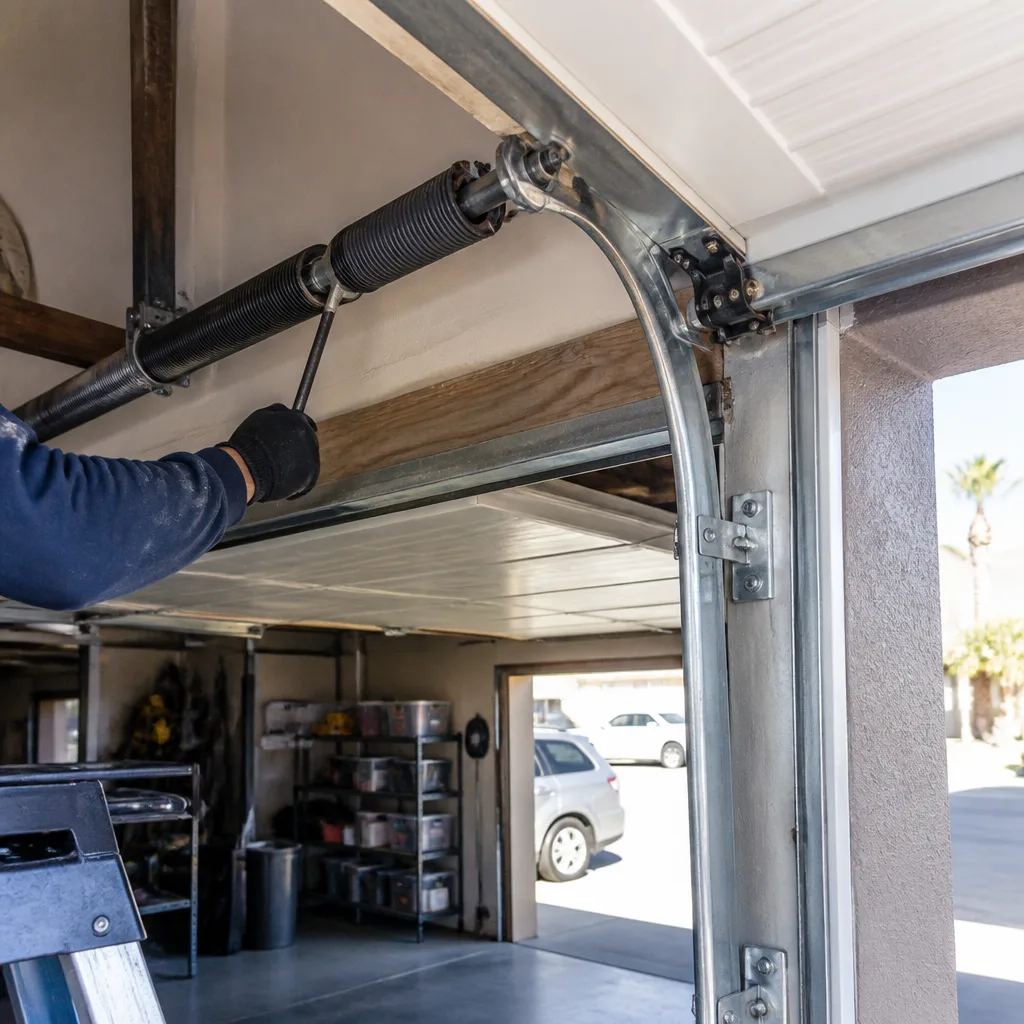
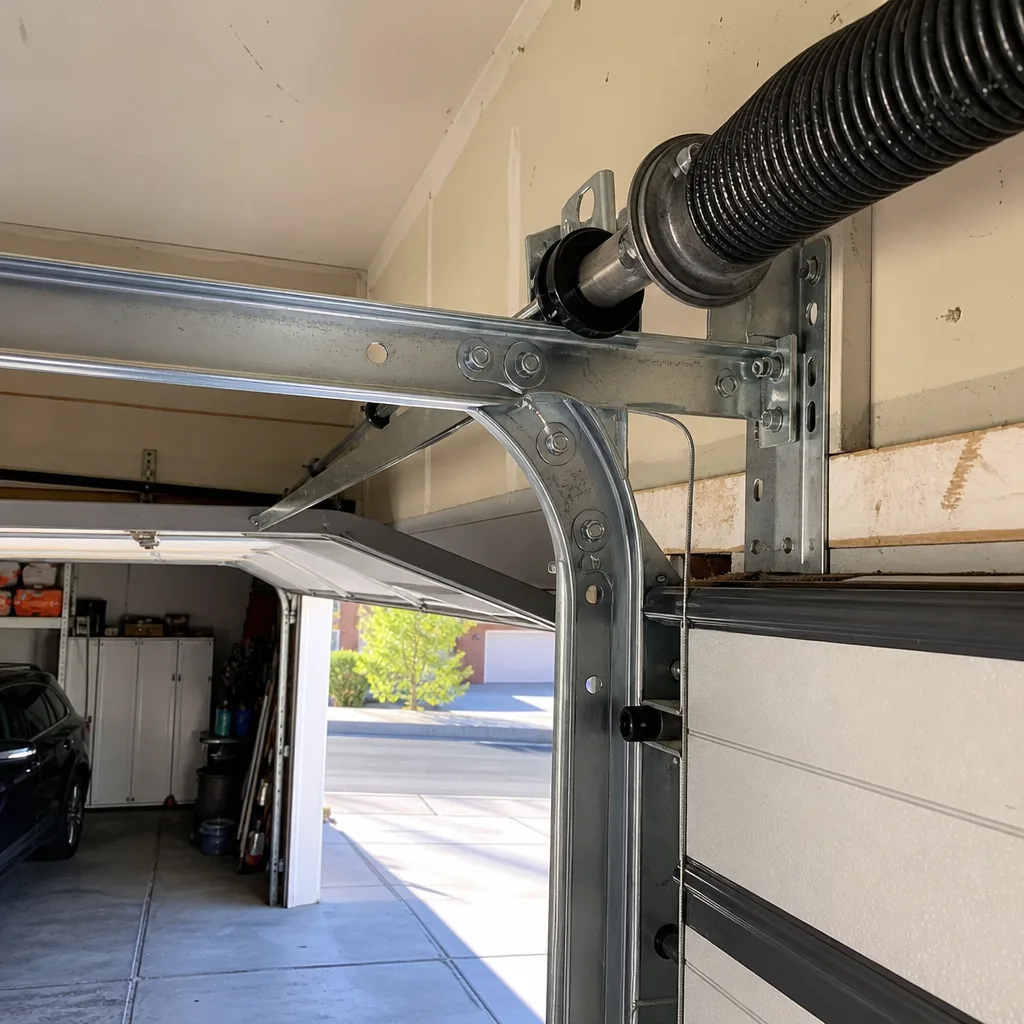
- Torsion spring replacement: No. The spring is under maximum tension even when the door is closed. A slip here is a broken wrist, a shattered orbital bone, or worse.
- Extension spring replacement: No. Same energy, different location, and the safety cable installation is fiddly enough that a missed step leaves you with a spring-shaped projectile.
- Lift cable replacement: No. The cable carries the door’s full weight. When it frays, the door is already off balance. Removing it without the right winding process drops a 150-pound panel on whatever is underneath.
- Door panel replacement: No. A single panel replacement requires re-hanging the entire door’s weight distribution. One misaligned section means the door binds, the opener strains, and the springs wear unevenly.
- Opener motor replacement: No. The chain or belt tension, the force settings, the travel limits, and the safety reversal all need calibration. A mis-calibrated opener will crush whatever is in its path when the safety reverse fails.
- Track repair or replacement: No. Tracks must be perfectly parallel and plumb within a quarter inch. If they aren’t, the door derails or binds.
- Hinge and roller replacement on anything but the bottom roller: Bottom roller replacement is a maybe, but only if the door is correctly supported and the roller is not under tension. The other rollers are under lateral load. No.
- Garage door balancing: No. Balancing means adjusting spring tension, which is exactly the dangerous part. Call a professional any time the door feels heavy or won’t stay mid-travel.
- Opener rail or chain repair: The chain is pre-tensioned and the rail carries the trolley under load. No.
- Emergency release cord replacement: Surprisingly involved. The release mechanism seats inside the trolley, and a wrong reconnect means the opener won’t engage. No.
If you’re in Las Vegas and one of those no-go tasks is on your list, Garage Door Repair in Las Vegas is what we do every day, from Summerlin to Henderson to North Las Vegas.
Why Las Vegas Heat Changes the DIY Calculus
Las Vegas isn’t just hot. It’s hot in a way that affects metal differently than Phoenix, differently than Palm Springs. The daily temperature swing in summer, from 105 degrees at 4 p.m. to 80 degrees at 4 a.m., is a 25-degree cycle that repeats every single day from June through September. Spring steel expands and contracts with each cycle. Over three or four years of Vegas summers, that’s over 400 expansion-contraction cycles on a spring that was designed for maybe 10,000 cycles in a stable climate. The metal doesn’t just weaken. It becomes unpredictable.
Here’s what that means for a DIY repair. In a mild climate, a torsion spring under normal tension is dangerous but somewhat predictable. You can read charts, count turns, and calculate torque based on the door’s weight. In Las Vegas, a heat-fatigued spring doesn’t follow the chart. It might snap at 80 percent of its rated capacity. It might hold fine while you’re winding it and then release suddenly when you shift your grip. The safety margin you’re relying on is thinner here than it is anywhere else in the country, because the metal has spent years baking in a carport that often hits 130 degrees inside.
We’ve personally seen springs in Summerlin that looked fine from the outside but had micro-fractures along the coil that only showed up under a magnifying glass. A homeowner winding that spring by hand would have no way to know the coil was about to fail. The metallurgy explanation is straightforward: heat accelerates fatigue crack growth, and the daily thermal cycle, not just the peak temperature, does the damage. That’s why a 5-year-old spring in Las Vegas is often weaker than a 12-year-old spring in Seattle.
For homeowners, that changes the decision. If you’re replacing a roller or reprogramming a remote, the heat doesn’t matter. If you’re even considering touching a spring, cable, or anything under tension, the Las Vegas climate has already done damage you can’t see. That alone pushes the spring replacement decision firmly into professional territory. And if the spring does fail mid-DIY, you won’t have time to react. You’ll have a hospital bill that dwarfs any labor savings. Our Garage Door Spring Repair in Las Vegas service handles this every day, often within the same afternoon.
The 5 Tasks Las Vegas Homeowners Can Confidently DIY
Now the encouraging part. There are five garage door tasks you can absolutely do yourself, and doing them well will extend the life of your door and save you real money over the years. Here’s exactly how to do each one correctly, in the order that makes sense for a typical Las Vegas home.
1. Clean and Align the Photo-Eye Sensors
The photo-eye sensors sit near the bottom of the door track on each side, about six inches off the garage floor. If your door won’t close, they’re the first thing to check. Dust, spider webs, and desert grit accumulate on the lenses, and the sensors are sensitive enough that even a thin layer of dust will interrupt the beam. Here’s the step-by-step:
- Find both sensors and wipe each lens with a dry microfiber cloth.
- Check the small LED light on each sensor. If one is blinking, that sensor is misaligned or blocked.
- Loosen the wing nut holding the sensor bracket just enough to move it.
- Adjust the sensor angle until the LED turns solid, then retighten the nut.
- Test the door close cycle.
This takes ten minutes and you’ll do it a few times a year in Las Vegas, especially after wind events that blow fine dust into the garage.
2. Reprogram a Remote or Keypad
If your remote stopped working after a power surge, which happens regularly in Las Vegas summer thunderstorms, the fix is usually a reprogramming sequence, not a new remote. Check the opener’s manual for the specific brand sequence. For Chamberlain and LiftMaster units, you’ll press the “Learn” button on the motor head, then press the remote button within 30 seconds. Genie openers use a slightly different sequence that involves holding the remote button while pressing the learn button. You won’t hurt anything by trying, and if the manual is lost, every major brand publishes PDF versions online.
3. Replace the Bottom Weather Seal
The rubber strip along the bottom of your garage door hardens and cracks in Las Vegas heat faster than any other wear part on the door. When it cracks, you’ll see daylight under the door, feel the heat seeping in, and start accumulating dust and pests. Replacement is genuinely easy: open the door halfway, pull the old seal out of the T-channel along the bottom, cut the new seal to length with scissors, and slide it in. Ten dollars and twenty minutes. Do this every two to three years in this climate.
4. Clean the Tracks
The vertical and horizontal tracks collect dust and grit that causes the rollers to grind. Wipe them down with a dry cloth, nothing wet. Don’t use lubricant on the tracks, don’t try to straighten a bent track, and don’t loosen any track bolts. Just wipe and be done.
5. Lubricate the Manual Lock
If you have a manual slide lock on the inside of the door, spray a small amount of silicone lubricant into the mechanism and work the lock a few times. It’s a one-minute job that keeps the lock from seizing. Use silicone, not oil, because oil attracts dust and turns into a sticky paste.
For everything else on the list, especially anything involving springs, cables, or the opener itself, you’ll want to check our Garage Door Cable Repair in Las Vegas service. Cable work specifically goes wrong in ways that are not obvious until the door falls.
True Cost Comparison: DIY Spring Replacement vs. Professional
Let’s talk real numbers, because the DIY argument always starts with “I can get the spring for forty bucks.” Here’s the actual Garage Door Cost Breakdown: The Las Vegas Homeowner’s Reference for 2026 for a typical torsion spring replacement on a double-wide garage door in Las Vegas, comparing a homeowner who buys parts online and follows a tutorial against a professional service call.
DIY Torsion Spring Replacement: The Real Cost
- Spring pair (matched set): $60 to $110 online, depending on wire gauge and spring length. Note: you should always replace springs in pairs, because when one fails the other has the same number of cycles on it.
- Winding bars (proper cold-rolled steel, not rebar or screwdrivers): $25 to $45 for a pair. Using anything else as a winding bar is a hospital trip waiting to happen.
- Vise grips, socket set, safety glasses: $30 to $60 if you don’t already own them. Safety glasses are non-negotiable.
- Time investment: 3 to 5 hours for a first-timer, including watching the tutorial, measuring the old spring, ordering the wrong one the first time (this happens to most people), waiting for the return, and redoing the installation.
- Risk-adjusted cost: This is the number the tutorials never include. The ER visit for a torsion spring injury in Las Vegas runs in the thousands, even with insurance. Even a non-injury mistake (wound the wrong direction, wrong wire gauge, forgot to set the cable tension) means the door doesn’t balance, the opener motor burns out within a month, and you’re out another $400 for the opener plus whatever the spring correction costs.
Professional Torsion Spring Replacement: The Real Cost
- Typical Las Vegas market range: $180 to $340 for a standard double-wide torsion spring pair, including the springs, the winding, the balancing, and the safety check.
- What the pro does that the DIY can’t: measures spring wire gauge correctly, calculates cycle life, matches springs to door weight, winds to the exact tension, sets cable tension, balances the door, and tests the auto-reverse safety system before leaving.
- The part most homeowners don’t know: torque settings matter. Over-wound springs will lift the door too fast and wear out the opener. Under-wound springs make the door heavy and strain the motor. A professional service includes torque calibration.
- Guarantee: A professional job should come with a written guarantee. At Marlow Garage Door Repair Las Vegas, every spring replacement is covered by our 365-Day Done Right Promise. If the spring fails within a year, we come back and make it right for free. No DIY tutorial offers a warranty.
The honest comparison: DIY saves you maybe $100 to $180 on the spring job itself, before you factor in the value of your time or the risk. And you’re doing that job on a door whose springs are already heat-fatigued from Las Vegas summers, which is precisely when an amateur winding mistake is most likely. The math doesn’t hold up. For reference, we have a full Garage Door Spring Repair in Las Vegas guide with pricing detail and the exact steps our technicians follow, written in plain language.
How to Spot a DIY Tutorial That’s Fishing for Clicks
Some DIY garage door tutorials are helpful. Most are not. The difference matters, because on this particular topic, a bad tutorial isn’t just a waste of time. It’s actively dangerous. Here’s how to separate the two in under two minutes.
Red flag one: no mention of winding bar material. Any tutorial that says “insert a screwdriver or a piece of rebar into the winding cone” was written by someone who has never been in the room when a spring let go. Proper winding bars are cold-rolled steel. Rebar is soft, bends under torque, and slips out of the cone. A screwdriver snaps. If the tutorial doesn’t specify proper winding bars, close the tab.
Red flag two: no warning about paired spring replacement. Springs wear together. Replacing only the broken one means the other is a time bomb with the same cycle count. Any tutorial that recommends replacing just one spring is wrong, and the person who wrote it either doesn’t know garage doors or doesn’t care about the result.
Red flag three: no discussion of what happens when it goes wrong. A responsible guide will tell you what to expect if you slip: the injury mechanism, the ER reality, the fact that the spring doesn’t give you a warning. If the tutorial frames it as “this is easy and anyone can do it,” and never mentions the risk, it was written for ad revenue, not for your education.
Red flag four: the comments are full of people asking for help. This is the most reliable signal. If the comment section is a trail of unanswered questions like “my door won’t close after I did this” or “the spring flew off and hit the wall,” the tutorial skipped critical steps. Legitimate tutorials have comment sections that are mostly quiet, because the instructions actually worked.
Red flag five: no brand-specific instructions. A Genie opener’s force adjustment is not the same as a Chamberlain’s. A Clopay door’s balance point is not the same as an Amarr’s. Generic instructions that don’t ask what brand you have are incomplete by definition. Look for tutorials that name the brand and model and show the specific steps for that unit.
Warranty and Insurance: What Most Guides Skip
There’s a second cost that DIY garage door guides almost never mention: what happens to your warranties and your insurance when you do the work yourself.
Your garage door opener, whether it’s a Chamberlain, Genie, or LiftMaster, came with a parts warranty. Most opener manufacturers state in the warranty document that the warranty is voided if the opener is damaged by an improperly balanced or misaligned door. If you replace your own springs, get the torsion wrong, and the opener motor burns out six weeks later, the manufacturer will not cover the replacement. That $300 saved on spring labor is now a $400 opener replacement.
Your homeowner’s insurance is another factor. If you attempt a spring repair, injure yourself, and file a claim, your insurer will investigate. Some policies include exclusions for injuries sustained during unlicensed work on mechanical systems. Others will cover the injury but then raises your rates because the claim was avoidable. And if your DIY repair fails and damages your car or your home, the claim is against your policy, not a bonded professional’s.
For Garage Door Permits, Codes & Inspections in NV: What You Need to Know and more, here’s what a professional service in Las Vegas should offer, and what we offer at Marlow Garage Door Repair Las Vegas: written pricing before work begins, a warranty in writing (ours is the 365-Day Done Right Promise), and technicians trained on the specific brands in your garage. That’s not a sales pitch. It’s the difference between having recourse when something goes wrong and having none.
Common Mistakes to Avoid
- Using the wrong tool as a winding bar. Screwdrivers, rebar, and pry bars are not substitutes for cold-rolled steel winding bars. The wrong tool bends, slips out of the winding cone, and sends the spring’s stored energy into your hand, arm, or face. This is the single most common injury mechanism in DIY garage door repair, and it is entirely preventable.
- Lubricating the tracks. Tracks are meant to be dry so the rollers can grip and roll. Lubricant on the track attracts dust and turns the track into a slippery, gritty mess. Lubricate the rollers, hinges, and springs instead.
- Disconnecting the opener without propping the door. If you pull the emergency release cord while the door is up, and the door is not properly supported, a broken spring now means the door slams down under its own weight. A 150-pound door panel falling from seven feet does serious damage to whatever is beneath it.
- Replacing only one spring. Springs have identical cycle limits. When one fails, the other is at the end of its life too. Replacing just one means paying for the second replacement within a few months and doubling the repair cost.
- Ignoring the desert heat’s effect on metal. Las Vegas springs age faster than the national average because of daily thermal expansion and contraction. A five-year-old spring here has already cycled past its safe operational range in many cases. Don’t judge a spring’s condition by how it looks; judge it by its age and the climate it has lived in.
- Buying the cheapest spring online. Springs come in different wire gauges, lengths, and cycle-life ratings. The $30 spring is often rated for 5,000 cycles, which in Las Vegas means it fails again within two years. A quality spring rated for 20,000 cycles costs more upfront and lasts four times as long.
- Skipping the safety reversal test. After any work on the door or opener, testing the auto-reverse is non-negotiable. Place a 2×4 flat in the door’s path and close the door. If the door doesn’t reverse within two seconds of contact, the safety system has failed. This is a life-safety issue, not a convenience feature.
When to Call a Professional
Call a professional when the task involves tension, weight, or precision. Specifically: torsion or extension spring replacement, lift cable repair, door panel replacement, opener motor replacement, track repair, and any job where the door feels heavy or unbalanced. These are the tasks where a single wrong move has serious consequences, not a dent in the drywall. In Las Vegas, the heat fatigue factor means you should move faster on spring and cable issues than you would in a cooler climate, because a weakened spring is a time bomb. Marlow Garage Door Repair Las Vegas offers free estimates in Las Vegas, and you’ll get a written price before any work starts. Call (725) 373-9798 and a real person answers, any hour of any day.
Frequently Asked Questions
You can safely handle sensor alignment, remote reprogramming, weather seal replacement, track cleaning, and manual lock lubrication-tasks covered in our Garage Door Repair Maintenance Checklist for Las Vegas Homeowners. These five tasks involve no stored spring energy and no risk of the door falling or binding. Everything else, especially springs and cables, requires professional training and tools.
A professional torsion spring replacement on a standard double-wide garage door in Las Vegas typically runs $180 to $340, including spring matching, winding, balancing, and safety testing. DIY parts run $60 to $110 for the springs plus tools, but you forgo the warranty, the torque calibration, and the safety margin, which doesn’t make financial sense on this particular task. Call (725) 373-9798 for an exact quote on your specific door.
Las Vegas’s daily summer temperature swing, often 25 degrees or more from afternoon to night, causes repeated thermal expansion and contraction in spring steel. Over hundreds of cycles, this accelerates fatigue crack growth, making springs weaker and less predictable than their counterparts in mild climates. A spring that looks fine may have internal fractures that fail without warning.
No. Garage door springs are installed in matched pairs and have identical life cycles. When one breaks, the other has the same number of cycles on it and will fail soon. Replacing both at once is cheaper and safer than replacing one now and the other in a few months.
First, check the photo-eye sensors for dust or misalignment, which is the most common cause. Clean the lenses and check the LED lights. If that doesn’t solve it and the door feels heavy or closes unevenly, you likely have a spring or cable issue that requires professional attention. For a fast response in Las Vegas, call (725) 373-9798 and we’ll diagnose it over the phone before scheduling.
Coverage varies by policy. Some insurers exclude injuries from unlicensed mechanical work, and others will cover the injury but raise your rates for a claim that was avoidable. If your DIY repair damages your car or home, the claim is against your policy. Professional garage door services carry their own insurance and bond, so the liability is theirs, not yours.
For the five DIY-safe tasks, yes, you’ll save money doing them yourself. For spring replacement, cable repair, and opener work, the numbers don’t support DIY. Parts and tools run $115 to $215 before you factor in three to five hours of your time and the risk of injury or a botched install. Professional spring replacement runs $180 to $340 with a written guarantee. The savings simply aren’t there when the risk is this high.
Ready to get it fixed right the first time? Call Marlow Garage Door Repair Las Vegas today for a free estimate. We’ll give you a written price before any work begins, and our 365-Day Done Right Promise backs every repair.
The Bottom Line
The DIY versus professional question for garage doors in Las Vegas comes down to a single principle: tasks without stored energy are homeowner territory, tasks with springs, cables, or openers under load are not. For more guides & resources on keeping your door safe, explore our blog. The five safe DIY tasks will save you a few hundred dollars over the life of your door and are genuinely simple. Everything else, especially spring and cable work, carries a risk profile that no amount of YouTube confidence will change. Las Vegas heat makes the spring work more dangerous here than almost anywhere else in the country. When the job involves tension, call a pro. Get a written price before work starts. Get a real warranty in writing. And if you’re in Las Vegas, get both from the team that’s been doing this since 2002.
Written by Jaylen Ross, Owner at Marlow Garage Door Repair Las Vegas, serving Las Vegas since 2002.
See the difference
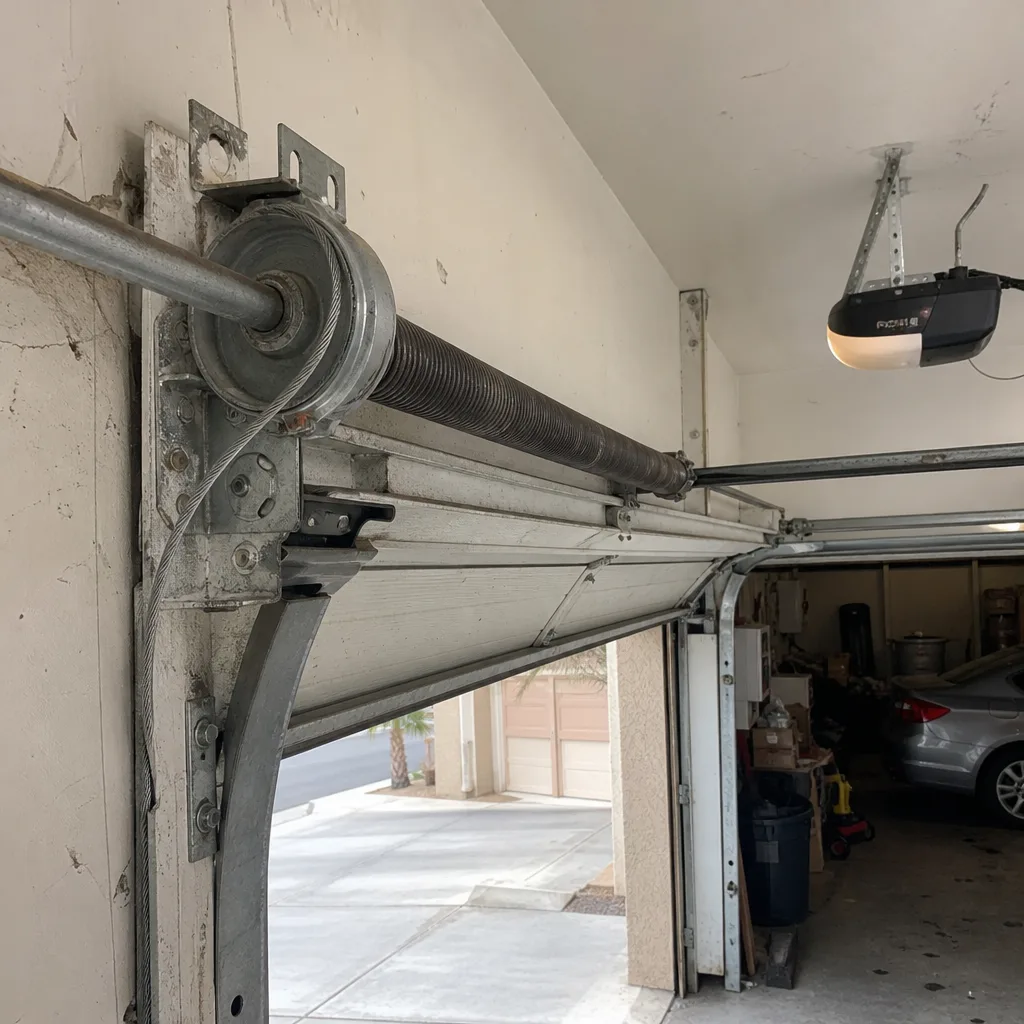 Before
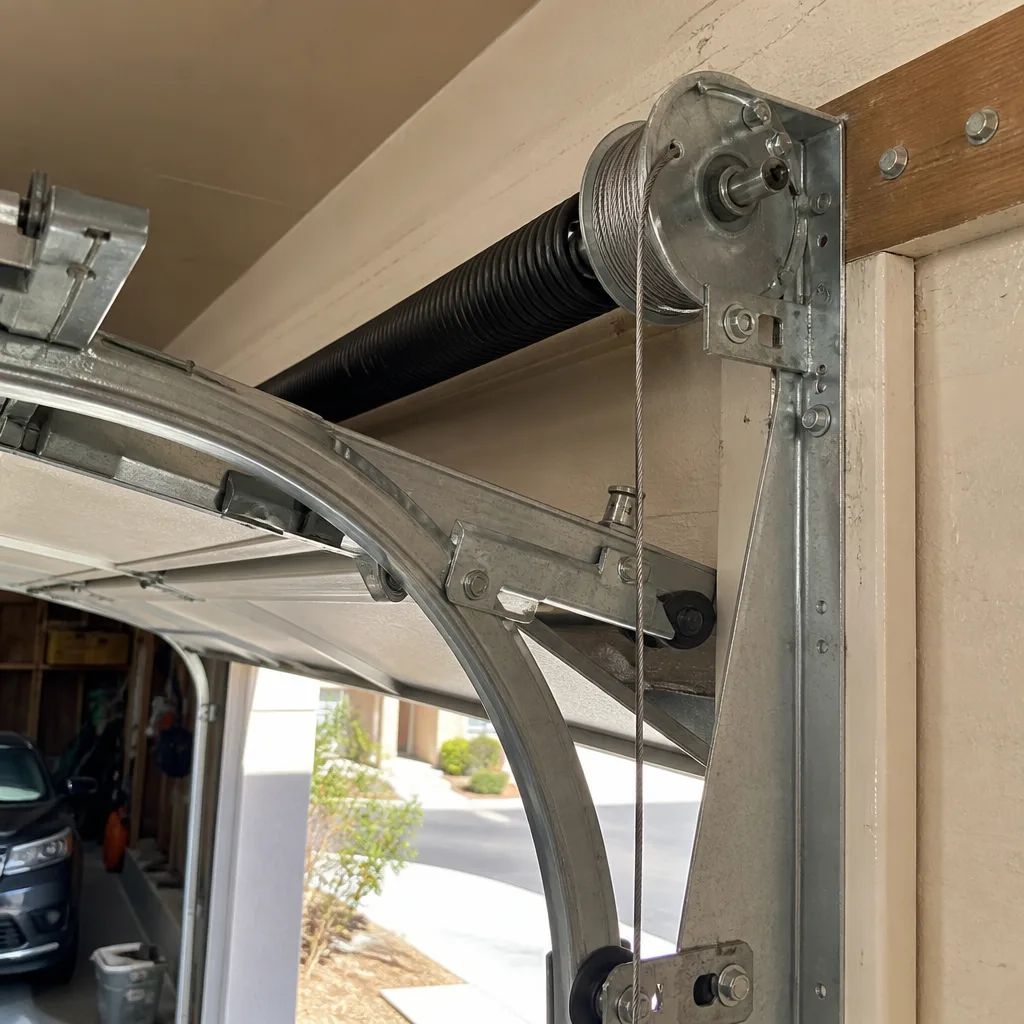 After
After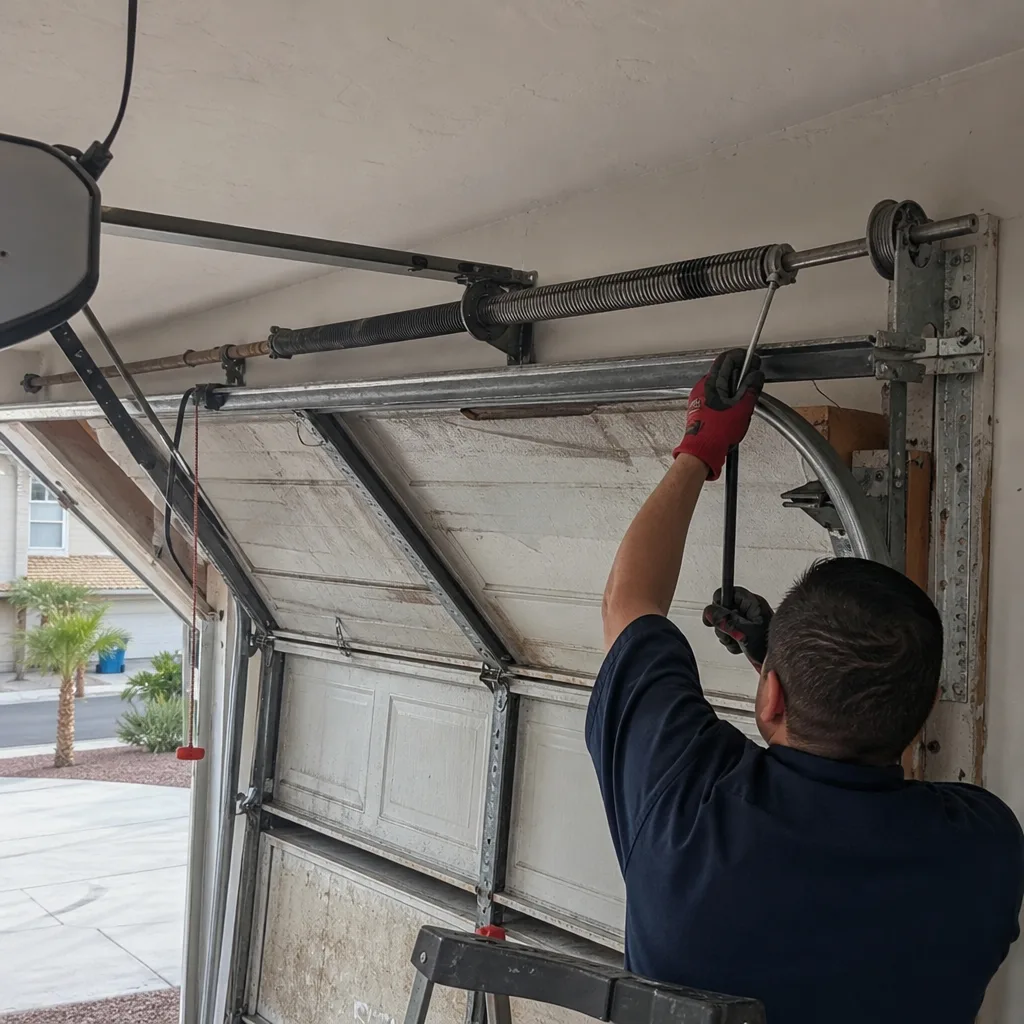 Before
 After
After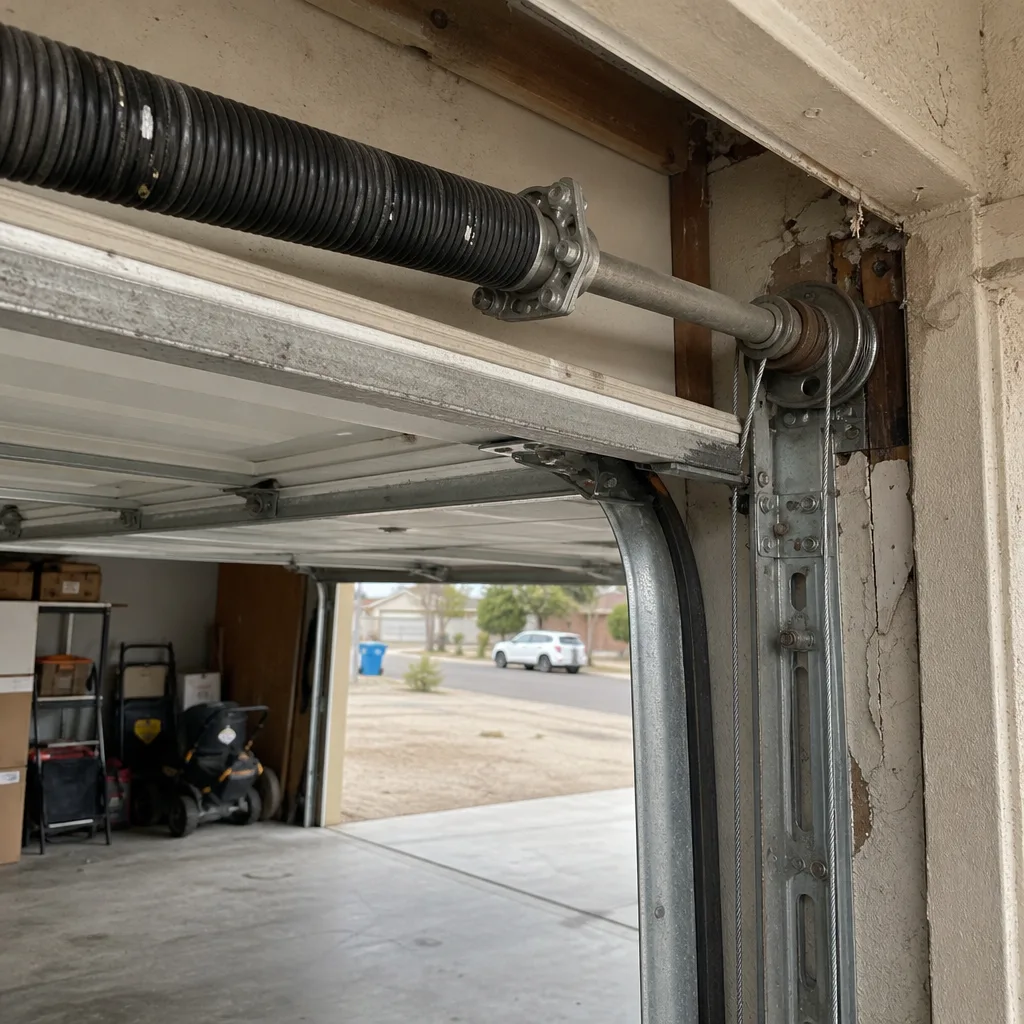 Before
 After
After